Award-Winning Poem Featured in ‘Boomerlitmag’

My poem Dream and Dream and Dream, which was long-listed for the 2023 Fish Publishing Poetry Prize, has been published in the highly-rated Boomerlitmag. The journal is #58 on a highly-regarded list of the top literary magazines. The ratings are based on the number of their contributors from the previous year who are selected as winners of the coveted Pushcart Prize. As an example, Paris Review is ranked #1.

Here is the link: https://boomerlitmag.com/allen-shadow-2/ and the poem is posted below.

Dream and Dream and Dream

Mama, as everything was going on
I was watching, always watching you

crossing the Bronx streets when I was five
taking my big sister to school

you were crossing me
but, really, I was crossing you

when my father would let go your hand
in the middle of a vast boulevard

when cars rumbled when trucks roared


Always, mama, always
wanting to make it better for you
even though there was no way

when Superman flew
the blind girl around the world
and she could see again

I wanted him to come break
through the front windows
and take you

bring you back seeing
setting you down in the little square
living room or on the back porch

so you too could see all the
birds and the great Oak
and then could dance

around the corner
along Southern Boulevard
all the way to Tremont


All the places, just think, mama—
the story clouds, the platypus at the zoo,

elephants, the island in the Pacific
where, surely, you’d be a princess


Just think, we could cheat the
night custodian to off-load all the fear

and float on the aimless wind—
the sky is loud, mama, loud


Well, I could always go to sleep, anyway
and dream and dream and dream

sometimes there’s a song you can’t know
but you can sing, nonetheless

Finalist for the Robert Day Award for Fiction

I’ve been named a finalist for the Robert Day Award for Fiction, from the noted literary magazine New Letters. The editors are currently considering which finalist short stories it will publish in the magazine.

The short story I submitted, A Day in the City, is one of the first I began writing when, in the 1990s, I felt I finally had my fiction legs under me. I always thought it was a strong, worthy story, and as an example of how kooky discovery is in this field, the story has been rejected by magazines 52 times over the years (despite receiving very strong comments from a number of top editors). Even now, while I feel this award has validated my feelings, the story still may not be selected for publication. And, until it is, I can’t show it here or anywhere else, since it must be virginal to be considered by magazines. Tough stuff, eh? And I’ve had many similar experiences with poems, manuscripts, songs, and screenplays. Fortunately, however, in the case of poems, many that have been rejected numerous times, have finally been selected for publication. Ahh!!!

As I’ve been watching the baseball playoff games this October, I’m reminded of the fortitude required of professional baseball players. The other night it was noted how one outfielder in the game, now 28, had played in more than 700 minor league games before being called up to the majors last month.

BTW, New Letters is ranked #37 on a highly-regarded list of the top lit magazines. The ratings are based on the number of their contributors from the previous year who are selected as winners of the coveted Pushcart Prize. As an example, Paris Review is ranked #1.

I Read Your Letters, America

For Indigenous Peoples’ Day, I offer this poem of mine

I Read Your Letters, America*

So now I know about your lies
lies you told Sitting Bull
and Chief Joseph
over and over again
before the God mountains
and sacred grass

So now I know about your bullets
and your torture
how you tore the hearts from the Lakota, the Apache and the Nez Pers
how you tried to stretch their souls onto a cross

Shame on you, America
I didn’t know my father was a thief
it will be hard now to ride in the Buick
with the top down
the radio dancing over the corpses under the highway

*Will appear in the fall edition of Waymark magazine

‘The Beautiful Winding’ Selected in Major Poetry Book Competition

Today I learned my poetry manuscript The Beautiful Winding was recognized as an honorable mention in the 2023 Stevens Poetry Book Competition, judged by the distinguished poet Edward Hirsch, a National Book Critics Circle Award winner and MacArthur “Genius Grant” recipient. In addition, he is president of the John Simon Guggenheim Memorial Foundation and is a Chancellor of the Academy of American Poets.

Last year’s winner, Nancy Hengeveld

There were three winner categories and three honorable mentions, from 249 submissions world-wide. At first blush an honorable mention might not seem like something to crow about. But it’s huge to have a manuscript recognized in this class. It’s telling you you’re not crazy, your stuff is that good, and gives you extra oomph to keep pushing for The Beautiful Winding to become a winner and to be released by a top publisher. The competition these days is stiffer than ever.

I write every day. It’s something I’ve done most of my adult life, as poet, novelist, and songwriter. That said, since I retired from my job six years ago, I’ve been able to put my shoulder into submitting my stuff—to agents, publishers, magazines, etc. I’ve had individual poems published by some of the best literary magazines. So now I can hope to become a winner in the book category, as I keep pushing.

Shadow’s NY Times Story Included in ‘Best of 2015’

The piece I wrote as part of the New York Times “Walking New York” feature last spring is included in the Times feature: “2015: Our Best Visual Stories and Graphics.” The feature is published in today’s online edition.

To find my piece, click here, scroll down to the “Walking New York” story and search “Kovler”. Or, even simpler, click here, to read it (it’s a short piece) on this blog. I wrote this one under my given name, Allen Kovler vs. my penname, Allen Shadow.
Times_Best_2015

Shadow in Online Edition of The NY Times

Just to clarify, my story appears in the online version of the “Walking New York” Magazine feature in The Times, and doesn’t appear in the print edition. If you’re looking, click here and search “Kovler” in your browser to find it quickly.

NYT_Kovler


Shadow Published in New York Times

The New York Times published a piece I wrote as part of their Walking New York feature for this Sunday’s Magazine. In addition to a number of prominent writers, others were invited to submit a story of about 600 characters, and mine was one of few that made the cut.
NYT_Kovler
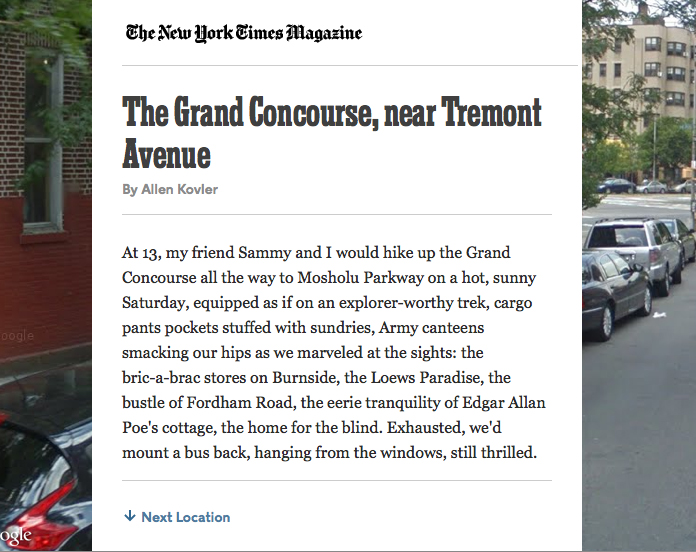
I wrote about a boyhood adventure along the Grand Concourse, in the Bronx:

The Grand Concourse, Near Tremont
By Allen Kovler (aka Allen Shadow)

At 13, my friend Sammy and I would hike up the Grand Concourse all the way to Mosholu Parkway on a hot, sunny Saturday, equipped as if on an explorer-worthy trek, cargo pants pockets stuffed with sundries, Army canteens smacking our hips as we marveled at the sights: the bric-a-brac stores on Burnside, the Loews Paradise, the bustle of Fordham Road, the eerie tranquility of Edgar Allan Poe’s cottage, the home for the blind. Exhausted, we’d mount a bus back, hanging from the windows, still thrilled.

‘Finding Robert Frank Online’ and Beyond

The other day The New York Times covered the announcement of a treasure trove of images from the work of Robert Frank, one of the most influential photographers of the 20th century. The National Gallery of Art has released a comprehensive archive of Frank’s work, including contact sheets and work prints, much of it never before seen by the public. It all comes in advance of Frank’s 90th birthday, in November.

As The Times says in it’s Lens Blog:

The cover image for the U.S. edition of The Americans, Robert Frank’s epochal book, spoke volumes about the state of the nation in the mid-1950s. The tightly-cropped photo shows passengers in the windows of a New Orleans trolley assuming their place in the social order of the Jim Crow South — progressing from a black woman in the rear to white children and adults up front (slide 4).

The contact sheet that contained the image showed that Mr. Frank had photographed the city from multiple perspectives, but he ultimately selected the frame that most dramatically and symbolically captured New Orleans’ racial hierarchy. Learning this photo’s backstory would be impossible without the ability to view Mr. Frank’s contact sheet. Now, such important archival material, typically reserved for scholars and curators, is just a click away.

Born in 1924 in Zurich, Switzerland, Frank took pictures in Europe and South America during his early career, but it wasn’t until he crisscrossed the seductive roads of America that Frank felt he was finally making art with his lens. With his U.S. travels in the mid-1950s, his work reached a new level, and 83 of his road images were arranged into the book The Americans.

It’s no surprised that Jack Kerouac wrote the introduction to the first U.S. edition of The Americans. The 1959 edition raised eyebrows in the media for its brute black and white candor. But The Americans, like Kerouac’s own masterwork, On the Road, opened the door to the loneness of the country’s heart and spirit and, together, they inspired a generation of artists, musicians and thinkers.

It’s interesting how foreign image makers like Frank, Mechelangelo Antonioni (Zabriskie Point, 1970), Louis Malle (Atlantic City, 1980) are able to capture the essence of the land better than most native auteurs. In fact, with the stir made by The Americans, Frank was compared to America’s original outsider observer, Alexis de Tocqueville, whose 1835 book Democracy in America helped to define the young nation’s unique character (Is it what America brings to you or what you bring to her?).

I believe a great artist is a conduit for “place.” His subject somehow finds him, speaks through him. The artist ultimately “sees” through time as the French photographer Eugène Atget once described it. I believe such artists also see through other dimensions, some of which elude us, some of which speak through intersections of light and shadow, artifact and art, quietude and cacophony, moment and mystery.

It’s hard to describe The Americans. Language could illuminate it, could degrade it. Perhaps it’s like the stuff of dreams, the magic of which begins to disappear upon transfer to the conscious mind. So much spills from the bucket on its ascent from that deep, dark well.

I was surprised and pleased when I discovered Frank himself had linked the worlds of photography and poetry in his description of his work:

When people look at my pictures I want them to feel the way they do when they want to read a line of a poem twice.
Has Al-Qaida Been Reinvigorated?

In the lead story in today’s New York Times, senior terrorism correspondent Eric Schmitt — who recently wished me luck with my 9/11-launched novel “Hell City” — writes:

The attack on the United States mission in Benghazi, Libya, that killed Ambassador J. Christopher Stevens has set off a new debate here and across the Middle East about whether Al Qaeda has been reinvigorated amid the chaos of the Arab Spring or instead merely lives on as a kind of useful boogeyman, scapegoat or foil.

There’s a great debate going on in Washington and the Middle East over whether al-Qaida (I use the AP-style spelling) is operational or whether newer insurgent groups are simply deploying its terrifying brand. That’s kind of where the term al-Qaida 2.0 comes from.

One thing is certain: there is no shortage of entrenched, sophisticated insurgent groups, the Haqqani clan in the Af-Pak region being one of the most dangerous. They have been responsible for most of the attacks on embassies in the region and many attacks on our troupes. It’s possible they are behind the recent deadly bombing in Kabul, another protestation over the Youtube-posted film under the name of “Innocence of Muslims,” although so far a branch of the insurgent group Hezb-i-Islami has claimed responsibility.

Consider this: it was the Kabul bombing, taken together with the other attacks across some 40 cities in the Middle East and North Africa, that led the U.S-led coalition to curtail operations with Afghan security forces, the very core of what remains of our mission in Afghanistan. Talk about decimation. Man, what do we have left?

Image

So, the idea that organized, sophisticated insurgency, jihad, has somehow been defanged in the Middle East and beyond is simply nuts. The entire region is on fire and is coming apart at the seams.

Which brings me to the plot of “Hell City.” As the protagonist, counterterrorism commander Jack Oldham, believes: “Al-Qaida isn’t dead — yet!” What Jack believes is that we can’t go to sleep on the “new gen” al-Qaida as he and his comrades call it, which is why they track American-born insurgents and their connections to various groups in Af-Pak and Yemen. Among them, by the way, is a fictionalized version of the Haqqani tribe. Can the reconstituted Qaida pull off another “big one” in New York? Well, that’s what reading (click for Kindle page) is all about.

Honeyboy’s Grammy: A Moment for a Great American Voice

The legendary bluesman David “Honeyboy” Edwards received a lifetime achievement award at last night’s Grammy Awards ceremonies. One of the last of the first generation bluesmen, Honeyboy was a close pal of Robert Johnson and a contemporary of Charley Patton and other blues pioneers.

The 94-year-old Honeyboy was instrumental in establishing a unique American voice, one that was born of slavery and struggle, spirit and magic. It’s a rich history that begat rock and roll and even rap. Artists from Bob Dylan and the Rolling Stones to Jay Z emanate from those underpinnings, and many more contemporary artists have paid homage to this field of music from which they came.

If the blues seems like a quaint, dusty, irrelevant music genre, give a listen to Howlin’ Wolf, Muddy Waters, Johnson and Honeyboy. Listen long in the dark with your eyes closed and go on a journey to the center of the American music universe. And when you turn the lights on, read a copy of the late Robert Palmer’s “Deep Blues,” a thorough primer on the music and its handprints on American culture.

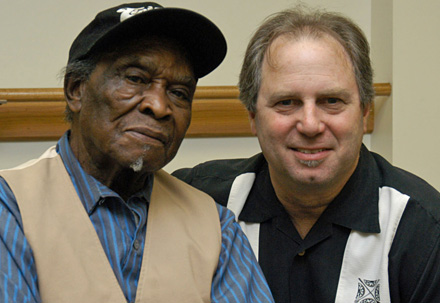
Dave "Honeyboy" Edwards, left, and Allen Shadow.

I got a chance to talk with Honeyboy after one of the many blues concerts I’ve promoted over the years that have included the likes of Buddy Guy, Koko Taylor, James Cotton, Earl King, Little Milton, Odetta, Pinetop Perkins, Hubert Sumlin, Willie “Big Eyes” Smith and Clarence “Gatemouth” Brown. Honeyboy was as charming as he was informative, happy to tell stories of Johnson and the early days. I considered it an honor and was pleased to see this giant of American music recognized last night.
Add to Technorati Favorites
Rock Music Blogs - BlogCatalog Blog Directory