Bye Neil, and Thanks

Seems like we’re more consumed with headshots — a la gunmen gone postal — these days, but mid-20th century it was moon shots. Actually meant something back then. The NASA rover Curiosity is bombing around Mars at the moment — unmanned, of course. But the country is more consumed with cat vids. Whatever happened to dreaming? Big ideas? Big steps?

One small step

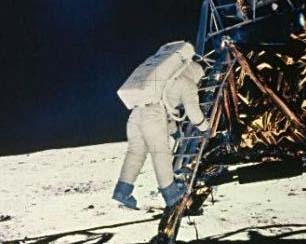
Certainly, Neil Armstrong knew something about big steps. The iconic astronaut passed away Saturday at the age of 82. I have my own memories of that fateful day, framed by the surreal counterpoints of the times. Following is an excerpt from a post commemorating the 40th anniversary of that moon landing.

I was in a second-rate hotel in Eureka, California the day the Apollo 11 crew landed. I was with my own merry band of pranksters on a cross-country trip in my 1948 Cadillac hearse. As we descended into the hotel lobby, Walter Cronkite’s voice crackled from a TV, saying something like, “What a great county…I just don’t understand these hippies…” The TV was a table model that sat on a broken Sylvania console. Behind these proceedings, a derelict American Indian lumbered along the street in the hot California sun. What an ironic scene. Could have been out of an Antonioni film.

P.S. Okay, so was originally thinking of heading this post with some play on “the Eagle has landed.” Didn’t. Then, the next morning, while shaving, I looked out my bathroom window to see a magnificent bald eagle wheel across my front lawn, lighting in a big oak. How’s that for synchronicity?

Add to Technorati Favorites
Rock Music Blogs - BlogCatalog Blog Directory

The Hot Ride

A heat bomb hit me when I slid into my Chevy today, a welcome rapture after an icy winter in upstate New York. It took me right back to the tireless Nash that was heaped among the weeds in my boyhood, nested among toads and copperheads in a bungalow colony in Peekskill.

A James Deanish boy named Leif was my summer partner in crime. He was the true grit country boy, I, the city kid learning the ropes. We were just short of teenage, and that mechanical skeleton was our rocket to the moon.

We sat in the stultifying July sun, hornets circling; our souls exulted from the dusty upholstery scents as we took turns behind the hot steering wheel, the battered speedometer feeding our imaginations. The cracked and crazed sheet metal became a time machine, taking us on far journeys through states that were as yet unknown. Our young hearts baked and burned. Turn after turn, we explored, escaped as if mapping out the rest of our lives.

I have no idea what happened to Leif after that summer. Year after year, my own soul baked on: in my father’s Studebaker, Dodge; in my first car, a 1948 Cadillac hearse. That black monolith took me to California and back twice, tracing every road I had imagined in that magical Nash.

It persists. I’ve since traveled the back roads of most states. My wife, Roxanne and I continue the journey every chance we get: Cross Creek, Savannah, New Orleans, Pueblo, Greensboro, Kansas City, Barstow, Staunton, Albuquerque. Somehow, it’s always just beginning, when the sun enwraps you behind the wheel.

America is in my blood, my bones, as evinced in my writing. Check out this raw reality in the video to my song “Miss America.”
Add to Technorati Favorites
Rock Music Blogs - BlogCatalog Blog Directory

Catcher 22: Holden Caulfield Today

“The Catcher in the Rye” was as singular a novel as the voice of J.D. Salinger, who passed away on Thursday. To my generation – The Who, Woodstock and all that – it was the bible for the disaffected, misunderstood teenager, who was ready to flip from Peter Pan.

Of course, the flipping continued. After high school, there were new discoveries on the road, so to speak, to self-discovery: Kerouac, Ginsberg, Hemingway, Dylan, the Beatles, the Williamses (Tennessee and Hank), the Millers (Henry and Arthur), Lorca.

But today’s youth don’t have time for such protracted processes. As Jennifer Schuessler put it, writing in the New York Times last June:

Today’s pop culture heroes, it seems, are the nerds who conquer the world — like Harry (Potter) — not the beautiful losers who reject it.

Some critics say that if Holden is less popular these days, the fault lies with our own impatience with the idea of a lifelong quest for identity and meaning that Holden represents.

Since the 1980s, I’ve been saddened by the fast-track trajectory of college students. Pressure to choose a gilded career flattened any chance for soul searching during its ideal developmental period. No doubt many college students in recent times have bounced from major to major, from career to career, and have fallen under the wheels of life a few times. Yet something still seems lost in today’s culture.

Nevertheless, I’m convinced there’s something inherent in human nature that seeks its own inquisitive level despite the “so now” pressures and distractions of the times. Our three-year-old grandson, Russell is as spoiled with store-bought toys as many, but I was heartened to see that his favorite play thing of late is an empty chewing-gum box — the best gift his pappy ever gave him.

The soul lives on.
Add to Technorati Favorites
Rock Music Blogs - BlogCatalog Blog Directory

“Robert Frank’s The Americans” at the Metropolitan

I just saw the exhibit “Robert Frank’s ‘The Americans’” — centered on the photographer’s seminal book by the same name  — on display at the Metropolitan Museum of Art, New York, through Jan. 3.

Born in 1924 in Zurich, Switzerland, Frank took pictures in Europe and South America during his early career, but it wasn’t until he crisscrossed the seductive roads of America that Frank felt he was finally making art with his lens. With his U.S. travels in the mid-1950s, his work reached a new level, and 83 of his road images were arranged into the book “The Americans.”

It’s no surprised that Jack Kerouac wrote the introduction to the first U.S. edition of “The Americans (1959).” It raised eyebrows in the media for its brute black and white candor. But “The Americans,” like Kerouac’s own masterwork, “On the Road,” opened the door to the loneness of the country’s heart and spirit and, together, they inspired a generation of artists, musicians and thinkers.
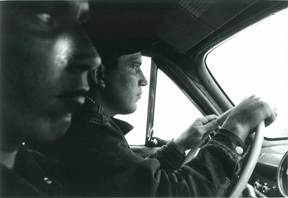
Robert Frank's "U.S. 91, leaving Blackfoot, Idaho"

It’s interesting how foreign image makers like Frank, Mechelangelo Antonioni (“Zabriskie Point,” 1970), Louis Malle (“Atlantic City,” 1980) are able to capture the essence of the land better than most native auteurs. In fact, with the stir made by “The Americans,” Frank was compared to America’s original outsider observer, Alexis de Tocqueville, whose 1835 book “Democracy in America” helped to define the young nation’s unique character (Is it what America brings to you or what you bring to her?).

I believe a great artist is a conduit for “place.” His subject somehow finds him, speaks through him. The artist ultimately “sees” through time as the French photographer Eugène Atget described it. I believe such artists also see through other dimensions, some of which elude us, some of which speak through intersections of light and shadow, artifact and art, quietude and cacophony, moment and mystery.

It’s hard to describe “The Americans.” Language could illuminate it, could degrade it. Perhaps it’s like the stuff of dreams, the magic of which begins to disappear upon transfer to the conscious mind. So much spills from the bucket on its ascent from that deep, dark well.

But I try. Actually, I thought poetry might somehow have a special access pass to the world within photography. So I offer up the following images from my forthcoming chapbook “America, I’ll Have My Way With You”:

I MISS YOU ALREADY AMERICA

I miss you already America
and you’re not even gone

leave me your messages
by the grimed phone booth
how you joke of the truth
hat tossed to eternity
leave me your hay bales
in the sweat hum of the field
waiting on farm hands
and wayward girls
leave me your Ford grillwork
idle at the company house
preaching at the two lane

leave me your truck’s whine
at the crossroads
singing that heaven
is elsewhere in the night
leave me your green trailer
singular at the corner
monument to guts
leave me your shag heart
dusting the television night
with boredom and blood

You might view the video of my song “Miss America,” too.

I was surprised and pleased to see Frank himself link the worlds of photography and poetry in his description of his work:

When people look at my pictures I want them to feel the way they do when they want to read a line of a poem twice.

Add to Technorati Favorites
Rock Music Blogs - BlogCatalog Blog Directory

Kansas City Star

Papa walked the great hall
of Union Station
learned to box the language
at the Star
on his way into the world’s war

on the cusp of Bird’s entry
into the warble of the world
from the flesh and iron
of Kansas City

yard town, hog center
breadbasket, whistlestop
9ths and 13ths and Vine
where the Western Auto sign
now blinks and punctuates
the Thomas Hart Benton landscape

Add to Technorati Favorites