Bye Neil, and Thanks

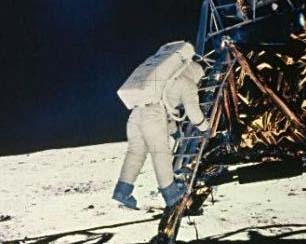
Seems like we’re more consumed with headshots — a la gunmen gone postal — these days, but mid-20th century it was moon shots. Actually meant something back then. The NASA rover Curiosity is bombing around Mars at the moment — unmanned, of course. But the country is more consumed with cat vids. Whatever happened to dreaming? Big ideas? Big steps?

One small step

Certainly, Neil Armstrong knew something about big steps. The iconic astronaut passed away Saturday at the age of 82. I have my own memories of that fateful day, framed by the surreal counterpoints of the times. Following is an excerpt from a post commemorating the 40th anniversary of that moon landing.

I was in a second-rate hotel in Eureka, California the day the Apollo 11 crew landed. I was with my own merry band of pranksters on a cross-country trip in my 1948 Cadillac hearse. As we descended into the hotel lobby, Walter Cronkite’s voice crackled from a TV, saying something like, “What a great county…I just don’t understand these hippies…” The TV was a table model that sat on a broken Sylvania console. Behind these proceedings, a derelict American Indian lumbered along the street in the hot California sun. What an ironic scene. Could have been out of an Antonioni film.

P.S. Okay, so was originally thinking of heading this post with some play on “the Eagle has landed.” Didn’t. Then, the next morning, while shaving, I looked out my bathroom window to see a magnificent bald eagle wheel across my front lawn, lighting in a big oak. How’s that for synchronicity?

Add to Technorati Favorites
Rock Music Blogs - BlogCatalog Blog Directory

Honeyboy’s Grammy: A Moment for a Great American Voice

The legendary bluesman David “Honeyboy” Edwards received a lifetime achievement award at last night’s Grammy Awards ceremonies. One of the last of the first generation bluesmen, Honeyboy was a close pal of Robert Johnson and a contemporary of Charley Patton and other blues pioneers.

The 94-year-old Honeyboy was instrumental in establishing a unique American voice, one that was born of slavery and struggle, spirit and magic. It’s a rich history that begat rock and roll and even rap. Artists from Bob Dylan and the Rolling Stones to Jay Z emanate from those underpinnings, and many more contemporary artists have paid homage to this field of music from which they came.

If the blues seems like a quaint, dusty, irrelevant music genre, give a listen to Howlin’ Wolf, Muddy Waters, Johnson and Honeyboy. Listen long in the dark with your eyes closed and go on a journey to the center of the American music universe. And when you turn the lights on, read a copy of the late Robert Palmer’s “Deep Blues,” a thorough primer on the music and its handprints on American culture.

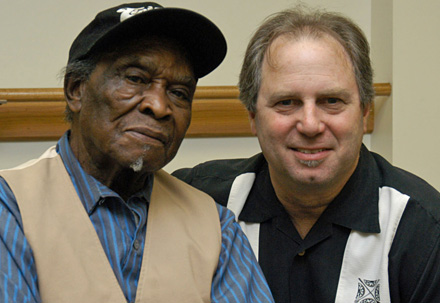
Dave "Honeyboy" Edwards, left, and Allen Shadow.

I got a chance to talk with Honeyboy after one of the many blues concerts I’ve promoted over the years that have included the likes of Buddy Guy, Koko Taylor, James Cotton, Earl King, Little Milton, Odetta, Pinetop Perkins, Hubert Sumlin, Willie “Big Eyes” Smith and Clarence “Gatemouth” Brown. Honeyboy was as charming as he was informative, happy to tell stories of Johnson and the early days. I considered it an honor and was pleased to see this giant of American music recognized last night.
Add to Technorati Favorites
Rock Music Blogs - BlogCatalog Blog Directory

Catcher 22: Holden Caulfield Today

“The Catcher in the Rye” was as singular a novel as the voice of J.D. Salinger, who passed away on Thursday. To my generation – The Who, Woodstock and all that – it was the bible for the disaffected, misunderstood teenager, who was ready to flip from Peter Pan.

Of course, the flipping continued. After high school, there were new discoveries on the road, so to speak, to self-discovery: Kerouac, Ginsberg, Hemingway, Dylan, the Beatles, the Williamses (Tennessee and Hank), the Millers (Henry and Arthur), Lorca.

But today’s youth don’t have time for such protracted processes. As Jennifer Schuessler put it, writing in the New York Times last June:

Today’s pop culture heroes, it seems, are the nerds who conquer the world — like Harry (Potter) — not the beautiful losers who reject it.

Some critics say that if Holden is less popular these days, the fault lies with our own impatience with the idea of a lifelong quest for identity and meaning that Holden represents.

Since the 1980s, I’ve been saddened by the fast-track trajectory of college students. Pressure to choose a gilded career flattened any chance for soul searching during its ideal developmental period. No doubt many college students in recent times have bounced from major to major, from career to career, and have fallen under the wheels of life a few times. Yet something still seems lost in today’s culture.

Nevertheless, I’m convinced there’s something inherent in human nature that seeks its own inquisitive level despite the “so now” pressures and distractions of the times. Our three-year-old grandson, Russell is as spoiled with store-bought toys as many, but I was heartened to see that his favorite play thing of late is an empty chewing-gum box — the best gift his pappy ever gave him.

The soul lives on.
Add to Technorati Favorites
Rock Music Blogs - BlogCatalog Blog Directory

PR Artillery Needed in Obama’s War Room

The elephants in President Obama’s war room are so faint on the media radar-screen as to be nonexistent. What pachyderms, you say?

How about, while the Republicans hammer the press on Barry’s warrior meter — including the Christmas Day debacle and his battle terminology – the administration has failed to remind the public that it helped take out some 30 al-Qaeda leaders in Yemen just weeks before Abdulmutallab took a bathroom break over Detroit.

Not to mention the dozens of successful drone hits in the outlaw hills of the ‘stans during the president’s scant time in office. According the Washington policy group The New America Foundation, as reported in the New York Times:

More C.I.A. drone attacks have been conducted under President Obama than under President George W. Bush. The political consensus in support of the drone program, its antiseptic, high-tech appeal and its secrecy have obscured just how radical it is. For the first time in history, a civilian intelligence agency is using robots to carry out a military mission, selecting people for killing in a country where the United States is not officially at war.

Obama’s stealthy war strategy keeps the left in the dark, and opens him to jabs from the right.

Furthermore, the president should court the moderate Muslim community, which is beginning to get ink stateside, albeit buried in the noise of political skirmishes, airport jitters and bloated bank bonuses.

As Tom Friedman revealed a week ago, the battle against terrorism requires meaningful participation from moderate Muslims.

…no laws or walls we put up will ever be sufficient to protect us unless the Arab and Muslim societies from whence these suicide bombers emerge erect political, religious and moral restraints as well — starting by shaming suicide bombers and naming their actions “murder,” not “martyrdom.”

I keep saying: It takes a village. The father (of Abdulmutallab), Alhaji Umaru Mutallab, saw himself as part of a global community, based on shared values, and that is why he rang the alarm bell. Bless him for that. Unless more Muslim parents, spiritual leaders, political leaders — the village — are ready to publicly denounce suicide bombing against innocent civilians — theirs and ours — this behavior will not stop.

In fact, national newscasts included American-flag-waving Muslims speaking out against terrorism outside the courthouse during Abdulmutallab’s arraignment.

Obama should meet with prominent Muslim groups asking for their help in taking back their proud religion and way of life. He should take to the podium and call for the heads of Saudi Arabia, Jordon and other moderate Middle East states to speak out and take a leadership role.

If I were his PR man, that’s what I’d tell him.

Allen Shadow (aka Allen Kovler) is a veteran PR man, accredited by the Public Relations Society of America.
Add to Technorati Favorites
Rock Music Blogs - BlogCatalog Blog Directory

google6e1703afb9ed7997.html

9/11 Redux: Intelligence Fails to I.D. Plot

Blame it on bureaucracy. Blame it on inter-agency culture wars. No matter, the ball dropping in the Flight 253 case is eerily similar to intelligence failures leading up to the Sept. 11 attacks.

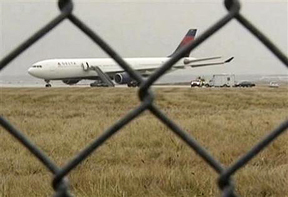
Flight 253 on the ground in Detroit.

This unfolding story is chilling. As reported in this today’s New York Times, the National Security Agency picked chatter from Al Qaeda leaders in Yemen outlining a terrorist attack involving a Nigerian man. But various intelligence agencies failed to put the pieces together and thwart Umar Farouk Abdulmutallab’s aerial act over the skies of Detroit.

Furthermore, agents at National Counterterrorism Center in Washington didn’t connect those National Security Agency dots, when Abdulmutallab’s prominent banker father, Alhaji Umaru Mutallab, made urgent appeals to U.S. State Department officials and the C.I.A. regarding his son’s radical intentions. According to the Times:

A family cousin quoted the father as warning officials from the State Department and the Central Intelligence Agency in Nigeria: “Look at the texts he’s sending. He’s a security threat.”

The cousin said: “They promised to look into it. They didn’t take him seriously.”

The new details help fill in the portrait of an intelligence breakdown in the months before Mr. Abdulmutallab boarded a plane in Amsterdam with the intent of blowing it up before landing in Detroit.

In some ways, the portrait bears a striking resemblance to the failures before the Sept. 11 attacks, despite the billions of dollars spent over the last eight years to improve the intelligence flow and secret communications across the United States’ national security apparatus.

Unfortunately, these calamitous events have produced mostly political finger-pointing and posturing. And officials have rushed to save face by burdening innocent air travelers with a series of ridiculous security measures. It’s like closing the airport door after the bomber is out. The solution is simple: make the inter-agency intelligence system work. In fact, start by search any of the 550,000 on the broader watch list when they show up at an airport. Isn’t that better than overburdening tens of millions daily.

The Times’ Scott Shane did an analysis of these events as well, comparing the current events with those of Sept. 11:

The finger-pointing began in earnest on Wednesday over who in the alphabet soup of American security agencies knew what and when about the Nigerian man charged with trying to blow up an airliner.

But the harshest spotlight fell on the very agency created to make sure intelligence dots were always connected: the National Counterterrorism Center. The crown jewel of intelligence reform after the Sept. 11, 2001, attacks, the center was the hub whose mission was to unite every scrap of data on threats and suspects, to make sure an extremist like Umar Farouk Abdulmutallab, the would-be bomber, would never penetrate the United States’ defenses.

“It’s totally frustrating,” said Thomas H. Kean, chairman of the national Sept. 11 commission. “It’s almost like the words being used to describe what went wrong are exactly the same.”

Add to Technorati Favorites
Rock Music Blogs - BlogCatalog Blog Directory

Homeland Security Homer Simpson Style

Here’s today’s terrorist watch-list quiz:

Create a “red flag” by combining any two of the following items regarding a potential terror suspect:

  • has no luggage
  • buys one-way ticket
  • pays cash for ticket
  • visa recently denied by Britain
  • prominent father reports son as potential terrorist to U.S. State Department
  • history traveling to Yemen

D’oh, and we have a winnah! It’s Homer Simpson. It’s also 99 percent of the American public and several classes of orangutans.

Yet the genius bureaucrats who clog up the works of our homeland security system all failed. The biggest loser: Janet Napolitano. She’s the master proctor for this exam, and she failed to even know how to grade it. As she told the Sunday morning talk circuit: “the system worked.” Her Monday morning backpedaling didn’t fill the bill either, and it took her boss’ eventual appearance at the podium to at least set the record straight, terming the homeland security affair a “systemic failure.”

For more coverage, check the following New York Times pieces: “Early Signs…” on today’s front page; today’s editorial on the subject; Clark Kent (no, not Superman) Ervin on the Op-Ed page; and, for laughs, master lampoonist Maureen Dowd who invokes cartoon logic to give perspective to these confounding events:

Were we clever and inventive enough to protect ourselves from the new breed of Flintstones-hardy yet Facebook-savvy terrorists?

If we can’t catch a Nigerian with a powerful explosive powder in his oddly feminine-looking underpants and a syringe full of acid, a man whose own father had alerted the U.S. Embassy in Nigeria, a traveler whose ticket was paid for in cash and who didn’t check bags, whose visa renewal had been denied by the British, who had studied Arabic in Al Qaeda sanctuary Yemen, whose name was on a counterterrorism watch list, who can we catch?

Add to Technorati Favorites
Rock Music Blogs - BlogCatalog Blog Directory

Turning the ‘Tide’ on Terrorism and Stupidity

The so called Tide list of some 550,000 wasn’t enough to detain — let alone stop — suspected terrorist Umar Farouk Abdulmutallab from boarding Flight 253 on Christmas Day as reported in the New York Times. The tip from his prominent banker father to U.S. Embassy officials wasn’t enough. And, as Britain’s Sunday Times reported, having his UK visa request refused this past May wasn’t enough either. Well, enough is enough.

The confounding practices surrounding information-sharing in the Abdulmutallab case are reminiscent of the ominous events leading up to the Sept. 11 attacks, when tips and red flags were bound in red tape.

To his credit, President Obama has called for an investigation of current practices regarding such lists as Terrorist Identities Datamart Environment (Tide), Terrorist Screening Data Base, no-fly, and selectee. To his discredit, the President has yet to step up to the podium to quell fears and set the record straight on mistakes behind the Flight 253 incident.

Certainly, the Sunday morning talk-show comments of Janet Napolitano and Robert Gibbs were laughable, and gave the impression of an administration that just doesn’t get it. Napolitano actually said, “the system worked.” It’s an insult to Americans’ intelligence that makes the administration look stupid, if not out of touch.

Rumors swirl that Obama will find a podium today or tomorrow. That would be smart, but regaining our “intelligence” is going to be an uphill slog following this Keystone Cops affair.
Add to Technorati Favorites
Rock Music Blogs - BlogCatalog Blog Directory

Mr. President, You’re Flunking Crisis Management 101

Mr. President, you need to find a podium, and fast. Even college freshman in PR 101 know that major crises require transparency and truth, all from the mouth of the CEO, and pronto.

Sending Napolitano and Gibbs out on such a mission is a joke, plain and simple, and a recipe for PR, even political, disaster.

Napolitano on WABC-TV “This Week” this morning said some confounding things:

That Umar Farouk Abdulmutallab was on some list, but there was nothing else to indicate he was a threat. Oh yeah, how about his distinguished banker father who weeks ago told U.S. Embassy officials in Nigeria that his son may be in the process of a terrorist act against the U.S.

Defying logic again, she had the gall to say: “everybody did what they were supposed to,” and that the government practices for exactly this type of event. Oh yeah! Even the commentator, Jake Tapper, to his credit, reminded her that the only folks who did what they were supposed to were the regular folks on that flight and the crew.

Robert Gibbs also buried the obvious failures in bureaucrat-speak about the alphabet-soup methodology of lists (i.e.: Terrorist Identities Datamart Environment, Terrorist Screening Data Base, “no-fly,” and “selectee”).

Mark my words, the ham-handed handling of this historic event on behalf of the administration will go down in PR-blunder history along with Bhopal and Exxon Valdez. This will serve as a textbook example for instructors of crisis management who will use it to point out everything not to do.

And PR aside, just wait till Leno and Letterman take to their respective podiums this week.
Add to Technorati Favorites
Rock Music Blogs - BlogCatalog Blog Directory

“Robert Frank’s The Americans” at the Metropolitan

I just saw the exhibit “Robert Frank’s ‘The Americans’” — centered on the photographer’s seminal book by the same name  — on display at the Metropolitan Museum of Art, New York, through Jan. 3.

Born in 1924 in Zurich, Switzerland, Frank took pictures in Europe and South America during his early career, but it wasn’t until he crisscrossed the seductive roads of America that Frank felt he was finally making art with his lens. With his U.S. travels in the mid-1950s, his work reached a new level, and 83 of his road images were arranged into the book “The Americans.”

It’s no surprised that Jack Kerouac wrote the introduction to the first U.S. edition of “The Americans (1959).” It raised eyebrows in the media for its brute black and white candor. But “The Americans,” like Kerouac’s own masterwork, “On the Road,” opened the door to the loneness of the country’s heart and spirit and, together, they inspired a generation of artists, musicians and thinkers.
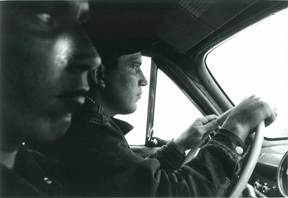
Robert Frank's "U.S. 91, leaving Blackfoot, Idaho"

It’s interesting how foreign image makers like Frank, Mechelangelo Antonioni (“Zabriskie Point,” 1970), Louis Malle (“Atlantic City,” 1980) are able to capture the essence of the land better than most native auteurs. In fact, with the stir made by “The Americans,” Frank was compared to America’s original outsider observer, Alexis de Tocqueville, whose 1835 book “Democracy in America” helped to define the young nation’s unique character (Is it what America brings to you or what you bring to her?).

I believe a great artist is a conduit for “place.” His subject somehow finds him, speaks through him. The artist ultimately “sees” through time as the French photographer Eugène Atget described it. I believe such artists also see through other dimensions, some of which elude us, some of which speak through intersections of light and shadow, artifact and art, quietude and cacophony, moment and mystery.

It’s hard to describe “The Americans.” Language could illuminate it, could degrade it. Perhaps it’s like the stuff of dreams, the magic of which begins to disappear upon transfer to the conscious mind. So much spills from the bucket on its ascent from that deep, dark well.

But I try. Actually, I thought poetry might somehow have a special access pass to the world within photography. So I offer up the following images from my forthcoming chapbook “America, I’ll Have My Way With You”:

I MISS YOU ALREADY AMERICA

I miss you already America
and you’re not even gone

leave me your messages
by the grimed phone booth
how you joke of the truth
hat tossed to eternity
leave me your hay bales
in the sweat hum of the field
waiting on farm hands
and wayward girls
leave me your Ford grillwork
idle at the company house
preaching at the two lane

leave me your truck’s whine
at the crossroads
singing that heaven
is elsewhere in the night
leave me your green trailer
singular at the corner
monument to guts
leave me your shag heart
dusting the television night
with boredom and blood

You might view the video of my song “Miss America,” too.

I was surprised and pleased to see Frank himself link the worlds of photography and poetry in his description of his work:

When people look at my pictures I want them to feel the way they do when they want to read a line of a poem twice.

Add to Technorati Favorites
Rock Music Blogs - BlogCatalog Blog Directory

Obama and Oslo: A Tough President for Tough Times

In Oslo, President Obama showed that he is more about humility than hubris and, in so doing, demonstrated why the committee gave him the Nobel Peace Prize, even if in Obama’s own characterization it could be viewed as premature:

I would be remiss if I did not acknowledge the considerable controversy that your generous decision has generated. In part, this is because I am at the beginning, and not the end, of my labors on the world stage. Compared to some of the giants of history who have received this prize — Schweitzer and King, Marshall and Mandela — my accomplishments are slight.

Yet, Obama has demonstrated how a world leader can be strong both militarily and diplomatically, without turning the free world against America as George W. did.

What surprises our politicians on both sides of the aisle is how tough this president is. He’s no wimp when it comes to using military force. In fact, he has been criticized, from the left, for sounding hawkish.

But he came to his “surge” decision in Afghanistan with the professorial scrutiny — contrary to W. — for which he is famous.
Add to Technorati Favorites
Rock Music Blogs - BlogCatalog Blog Directory