“Robert Frank’s The Americans” at the Metropolitan

I just saw the exhibit “Robert Frank’s ‘The Americans’” — centered on the photographer’s seminal book by the same name  — on display at the Metropolitan Museum of Art, New York, through Jan. 3.

Born in 1924 in Zurich, Switzerland, Frank took pictures in Europe and South America during his early career, but it wasn’t until he crisscrossed the seductive roads of America that Frank felt he was finally making art with his lens. With his U.S. travels in the mid-1950s, his work reached a new level, and 83 of his road images were arranged into the book “The Americans.”

It’s no surprised that Jack Kerouac wrote the introduction to the first U.S. edition of “The Americans (1959).” It raised eyebrows in the media for its brute black and white candor. But “The Americans,” like Kerouac’s own masterwork, “On the Road,” opened the door to the loneness of the country’s heart and spirit and, together, they inspired a generation of artists, musicians and thinkers.

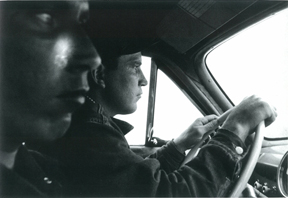
Robert Frank's "U.S. 91, leaving Blackfoot, Idaho"

It’s interesting how foreign image makers like Frank, Mechelangelo Antonioni (“Zabriskie Point,” 1970), Louis Malle (“Atlantic City,” 1980) are able to capture the essence of the land better than most native auteurs. In fact, with the stir made by “The Americans,” Frank was compared to America’s original outsider observer, Alexis de Tocqueville, whose 1835 book “Democracy in America” helped to define the young nation’s unique character (Is it what America brings to you or what you bring to her?).

I believe a great artist is a conduit for “place.” His subject somehow finds him, speaks through him. The artist ultimately “sees” through time as the French photographer Eugène Atget described it. I believe such artists also see through other dimensions, some of which elude us, some of which speak through intersections of light and shadow, artifact and art, quietude and cacophony, moment and mystery.

It’s hard to describe “The Americans.” Language could illuminate it, could degrade it. Perhaps it’s like the stuff of dreams, the magic of which begins to disappear upon transfer to the conscious mind. So much spills from the bucket on its ascent from that deep, dark well.

But I try. Actually, I thought poetry might somehow have a special access pass to the world within photography. So I offer up the following images from my forthcoming chapbook “America, I’ll Have My Way With You”:

I MISS YOU ALREADY AMERICA

I miss you already America
and you’re not even gone

leave me your messages
by the grimed phone booth
how you joke of the truth
hat tossed to eternity
leave me your hay bales
in the sweat hum of the field
waiting on farm hands
and wayward girls
leave me your Ford grillwork
idle at the company house
preaching at the two lane

leave me your truck’s whine
at the crossroads
singing that heaven
is elsewhere in the night
leave me your green trailer
singular at the corner
monument to guts
leave me your shag heart
dusting the television night
with boredom and blood

You might view the video of my song “Miss America,” too.

I was surprised and pleased to see Frank himself link the worlds of photography and poetry in his description of his work:

When people look at my pictures I want them to feel the way they do when they want to read a line of a poem twice.

Add to Technorati Favorites
Rock Music Blogs - BlogCatalog Blog Directory

Mignini Fiddled While Rome Burned

My wife just pointed out the ironic contrast between Amanda Knox prosecutor Giuliano Mignini and Italian Prime Minister Silvio Berlusconi. While Mignini reaped the rotten fruits of his distorted moral play against Amanda Knox, a million demonstrators took to the Roman streets asking for their corrupt leader’s political head. An excerpt from an Agence France-Presse report:

Former minister Rosy Bindi said she took part as a “simple citizen” and not as a representative of the Democratic Party (PD).

“It is significant that a large part of the country is reacting against and getting angry at a prime minister who doesn’t want to be judged and isn’t solving problems,” she told AFP.

Antonio di Pietro, a former anti-corruption judge and now leader of the Italy of Values party, denounced “the Berlusconi government’s great electoral, political, judicial and media swindle”.

Participants ranged from film director Nanni Moretti, who condemned Berlusconi’s domination of Italian television, to ecologists opposed to a planned bridge across the Straits of Messina and immigrant defense groups.

Protesters shouted “mafioso” at effigies of the billionaire prime minister, referring to a Mafia hitman who testified at a trial in Turin that his boss alleged Berlusconi had aided organised crime.

In league with the Italian mafia, Berlusconi recently vowed to strangle his detractors:

If I find out who is the maker of the nine seasons of ‘The Octopus’ and who has written books on the mafia, which give such a bad image to Italy across the world, I swear that I will strangle them.

Add to Technorati Favorites
Rock Music Blogs - BlogCatalog Blog Directory

Knox, Knox. Who’s There?

Injustice.

If you have a daughter or son in college who may spend a year studying abroad, you’re likely shaken over the Amanda Knox case.

Perugia prosecutor Giuliano Mignini is himself under investigation for serious transgressions regarding abuse of power, which includes heavy-handed tactics against journalists. Florence prosecutor Luca Turco recently called for his judicial colleague Mignini to be jailed for ten months, according to a report in Britain’s The Daily Mail.

In fact, weigh in with most any American journalist who covers the case — Vanity Fair’s Judy Bachrach and West Seattle Herald’s Steve Shay, who appeared recently on CNN or Seattle Times reporters — and you’ll discover disturbing practices of jurisprudence. It becomes clear that the fathers of Perugia, a conservative city in central Italy, had it in for a free-spirited American who simply didn’t act like the locals. Couple that with a veracious tabloid press, an unvetted jury that is permitted to read and view all manner of whacky media accounts, and you have a formula for disaster. Oh, throw in the fact that the defense was not permitted to challenge suspect DNA evidence with its own experts. Talk about having the jury stacked against you.

At this point, the Knox family and Washington State Sen. Maria Cantwell are making entreaties with the state department via Hillary Clinton. The appeals process will likely commence in October. The likelihood of an appellate turnover Italian-style depends on who you talk to. I spent time in Italy as a college student. While I didn’t run up against the law, I did run into a bureaucracy that makes Washington look like a walk in the park, and I was just registering my Fiat 500.

Hopefully, appeals and pressure from the U.S. State Department and European diplomats will help tip the scales of injustice.
Add to Technorati Favorites
Rock Music Blogs - BlogCatalog Blog Directory

‘In the Heat of the Night’ Italian Style: the Amanda Knox Verdict

Fast forward to the past, the American South of old: small town justice, small town sheriff, justice by prejudice. Only now it’s Perugia, the conservative, provincial Italian town, and the victim is Amanda Knox, the “angel faced” American college student plowed under by a railroad of bad press, bad judgment and bad practices in jurisprudence.

Here are a few good sources for this disturbing story:

  1. Vanity Fair contributing editor Judy Bachrach, who lived in Italy for four years and covered the Knox trial gavel to gavel. As she explained last night on CNN, the small-town Italian justice system derives directly from “the ancient inquisition.” The Knox prosecutor is himself the subject of an inquiry regarding other recent heavy-handed practices. Also, the Italian trial system is devoid of jury vetting and defense challenges to evidence, among other primitive processes.
  2. Such Knox family members as aunt Janet Huff. Huff has an astute understanding of the Perugia phenomenon, which includes gross prejudices fueled by a paparazzi-style Italian tabloid press that distorted innocent behavior and drew false conclusions from the get-go. See Huff’s video statement.
  3. West Seattle Herald reporter Steve Shay, who draws the same conclusions as Bachrach and Knox, from his independent investigation. He commented last night on CNN, with Jim Moret who was sitting in for Larry King.

Meanwhile, as Knox’s family pursues the painful appeals process overseas, Maria Cantwell, a U.S. senator from Knox’s home state of Washington, issued the following statement:

I am saddened by the verdict. I have serious questions about the Italian justice system and whether anti-Americanism tainted this trial. I will be conveying my concerns to Secretary of State Hillary Clinton.

Add to Technorati Favorites
Rock Music Blogs - BlogCatalog Blog Directory

‘It’s tough to beat up a guy that never quits’

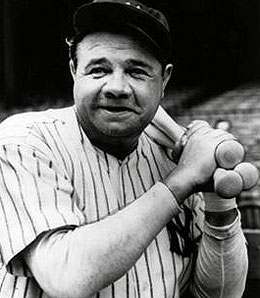
Babe Ruth mouthed that ungrammatical gem, and a slumping Nick Swisher of the New York Yankees just invoked it at a critical moment in his career.

Hang with me a moment, and you’ll see what this has to do with us music artists. Swisher made the last out in Game 5 of the American League Championship Series the other night. It was a frustrating moment, since a hit in that spot could’ve finished off the Angels and put the Bombers in the World Series.

With otherwise-clutch Swisher having only three hits in 29 at-bats this postseason, the temptation looms to sit the right fielder for another player. But manager Joe Girardi is keeping him in the lineup for the next critical game, and his reasons are exemplary. Girardi had a number of examples but the best came from his own postseason experience as a Yankees catcher. Girardi didn’t have a hit in the Yanks’ 1996 World Series as they entered a pivotal Game 6. He came through with what was to become a legendary triple. That clutch hit helped put the game and the series in the team’s column and set the stage for a dynasty period: four World Series titles in a five-year period.

Like a baseball season, a music career is a real grind. Baseball players play 162 games each season and more in the postseason, if they get there. Each year, even the best teams have high times and low. They play loose and have fun in the successful stretches and get tight when they play poorly. For short periods, even the best player can look clueless at the plate, his mechanics all out of whack. Then, inexplicably, he gets a cheap hit, and his sweet swing returns along with his confidence.

Out of the mouth of the Babe.

Out of the mouth of the Babe.

Likewise, artists at every level have similar swings, if you will. But, if you’ve had successes and you simply stay in the game, you can bet you’ll have more to build on.

Is this a pep talk? Yes. I give them to myself all the time.
Add to Technorati Favorites
Rock Music Blogs - BlogCatalog Blog Directory

You’re So ‘Yester-moment’

It’s no longer the flavor or the month or what used to be called 24/7 or wall-to-wall coverage. The new media cycle, at least for this nanosecond, is called “perpetual movement.”

In other words, spin or die. That’s the latest from Internet guru Michael Moritz, a Sequoia investor who backed Google, Yahoo and the Sugar Inc. blog-networks.

Quoted in a recent New York Times article, Moritz says:

Perpetual movement is the essence of survival and prosperity online. If online media and entertainment companies don’t improve every day, they will just wind up as the newfangled version of Reader’s Digest — bankrupt.

A second ago, it seems, we were talking about reinventing ourselves. But that’s so yesterday, or should I say so yestermoment.

What the Suger blog people have learned of late is that content on their successful networks must change constantly.

What this overall trend spells for us music artists is even scarier than the current biz model. Maybe the Web 2.0 atomizing machine will move us even further from the album, all the way to the ring tone (do not pass digital single).

Of course, I’m kidding, but only partly. After all, it is somewhat scary. The same warp-machine that devoured major labels, newspapers and publishing may chew us into yet smaller morsels.

For myself, I’m headed into my studio to record a new three-note masterpiece. Must adapt or die.
Add to Technorati Favorites
Rock Music Blogs - BlogCatalog Blog Directory

Musician: Why Your ‘Greatness’ is Missed

As music artists seek notice from fans and the industry, it’s vital to observe a key factor concerning peoples’ ability to recognize talent, even greatness.

You may have already read about the social experiment the Washington Post conducted two years ago with world-renowned violinist Joshua Bell. It was actually Bell’s idea to perform undercover as a street musician for a day at a Washington Metro station. What many don’t know is that the Gene Weingarten story earned a Pulitzer Prize that year for feature writing. What many do recall is the fact that a venerated violinist went virtually unnoticed, unappreciated and unrecognized.

What the public took away from the story — rightly so — is the fact that people pass up life’s jewels, even when they’re right before their, well, ears. But this tale holds a much greater meaning for artists of all stripes.

Center stage for artists sits the concept of context. What does that mean? For decades, I’ve observed that people, music industry pros included, often don’t recognize greatness in its raw form. When it comes to music, listeners need to have a song or an album framed for them in a validated form.

There are many examples, but here’s a case in point from my own experience as a songwriter and recording artist. In the late 1980’s, I began a ten-year stint as a Nashville songwriter. The first two years were rough, but when I got the hang of it my material and demos became street-ready, as they say. A number of those demos were sung by Trisha Yearwood. Then, she was known as Trisha Latham (her name from her first marriage), and was unsigned and unknown. The first demo I heard her sing on left me slack-jawed, and not just because of the material, which did eventually get signed to what was then PolyGram. By the time she hit the first chorus, I knew I was hearing a major star in the making.

But here’s the point. As I played those demos for music publishers and A&R execs, it amazed me that not a one commented on the singer. So I started what was to become an experiment of my own. I’d ask, “so what do you think of the singer?” They’d invariably say, “who is she?,” to which I’d reply, “Trisha Latham.” Then, they’d say something like “never heard of her,” and that was the end of it.

The reason they never heard of Trisha is because she was being developed privately through Garth Brooks’ camp. A&R in any music town expect to see upcoming talent in the clubs, so the assumption (as it was with Trisha) is: “if I don’t know her, she can’t be any good.” Again, it’s all about context.

Several months later, Trisha’s first single – “She’s in Love with the Boy” — came out, making Music City history for duration at number one for a female artist. By then, she had returned to her maiden name, Yearwood. I made the rounds of many of the same offices again, playing those Trisha-sung demos. This time, by the third note, I’d hear, “That’s Trisha Yearwood!,” to which I’d reply, “yeah, so where were you last year?”

Of course, we’ve all heard the stories of how most famous artists have their walls lined with record-label rejection letters, and, if you’ve paid some dues in the biz, you likely have a collection of your own.

So what’s the point of all of this? People – pedestrians and pros alike – miss greatness all the time. Even in the biz, there aren’t that many John Hammonds, Ahmet Erteguns and Russell Simmonses. If it were that easy to spot top talent, A&R would be a cinch.

So how is this study of use to the music artist? Simply as a point of reference, to understand why some audiences, some pros have been missing your best stuff. Maybe you’ll never write or produce a truly great song. But, if you work hard for a long, long time, chances are very good that you will come up with one, maybe more. For that reason, it’s vital to be armed with such perspective.
Add to Technorati Favorites
Rock Music Blogs - BlogCatalog Blog Directory

‘On the Road’ to Woodstock 40 Years After

Make no mistake, the Woodstock festival has been viewed with rose-colored glasses, especially from a 40-year vantage point. The event was essentially a massive, disorganized mud pit with a stage-view the size of a dime for most concertgoers. It was as much downer as upper. But, despite its faults, Woodstock was special in ways that defy definition.
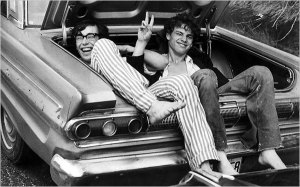
On the road to Woodstock

On the road to Woodstock

It sounds trite to say, “you had to be there.” But you did, and I was. My journey there was part of a summer-long road trip in my 1948 Cadillac hearse. But before I put the sleek three-ton black beauty in gear, let me go back a few years – to the Summer of Love – to put Woodstock in perspective.
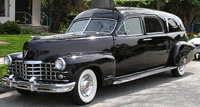
My Cadillac Hearse

It’s June 1967. I meet a college chum on Kingsbridge Road in the Bronx. “Did you hear about the festival? Are you going?,” she says. The festival in question was Monterey (California), and my reply was that I wanted to go bad, but didn’t think I could make it. That killed me. Music meant so much to us college kids back then. There weren’t a million channels of music. You could actually keep up with all of rock: the groups, the movements. You were at the record store when the new Stones album came out, the new Dylan.

That decade there were seismic cultural shifts on the music front year after year. But one needs to understand that the music front of the ’60’s included a major social revolution, one that impacted politics, family dynamics and both personal and interpersonal development.

When The Beatles’ “Sgt. Pepper’s Lonely Hearts Club Band” album came out a month before Monterey, it hit music lovers like a number 9 on the Richter scale. In 1968, The Band debuted with “Music from Big Pink,” blowing listeners minds. No one had envisioned such a sound: a literary gumbo of country, rock and Americana. Then, Bob Dylan, who had already remapped the music landscape in the early part of the decade, released “Nashville Skyline,” in 1969, turning the scene on its head yet again. Seminal events all.

And that’s just a brief snapshot of the ’60’s music-wise. Defined in chief by Elvis, the Beatles, Dylan, the Stones, Jimi Hendrix, and the Grateful Dead, the period was a turning point in the history of music, and culture overall. Let’s face it, the first three in the list make up the Mount Rushmore of 20th century rock.

Monterey, which featured Jimi Hendrix, The Who, Janis Joplin, and the Mamas & the Papas, was the first of the big music festivals; some say the best. It had a huge pull for us kids back then. Besides the music, there was the romance of “California Dreaming.” After all, it was the Summer of Love. Scott McKenzie’s “San Francisco (Be Sure to Wear Flowers in Your Hair”) beckoned from the radio. By July 1967, it was all too much to bear. I may have missed Monterey, but I wasn’t going to miss San Francisco and the Summer of Love. I quit my summer cooking job at Lenox Hill Hospital and set out with friends in a 1947 Cadillac limousine, nearly the same vehicle of Jack Kerouac’s “On the Road.” We put 10,000 mile on the odometer that summer, which included a long stop in Haight-Ashbury.

My friend Richard, the limo’s owner, was a collector of vintage Caddies, and, by 1969, I purchased a 1948 Cadillac hearse from him, my first car. The same year I married my first wife, Carol, and by the summer we had the behemoth packed for another cross-country adventure that included Richard, my sister, Alice and a brilliant folk singer named Ribsy.

Little did we know we were about to ride through history that July and August, with a strange experience in a beat northern California town during the Apollo 11 moon landing, a detention by the L.A. cops the morning after the Tate-LaBianca murders, and a momentous arrival in Woodstock as we rediscovered America. This post is the last of a triptych depicting those three notable dots on the map of the summer of 1969 (links to the previous two above).

When the L.A. cops released us on the morning of Aug. 11, we continued on our way to the festival. We already received our tickets while in California and hit the desert with great expectations. The collective pull of Woodstock was everywhere we went. Just outside of Needles, Calif., we encountered a converted mail truck full of freaks goin’ our way. And the way was Route 66, the curvy dream road that took us first through the West to Texas and north toward Chicago.

It’s probably difficult for today’s youth to understand that being different was not tolerated in many parts of the country in the ’60’s. Hippies, if you will (and I use the term affectionately), in those days got a tiny taste of what it must have been like to be black in America. Of course nothing could begin to compare to the latter experience, but the longhairs plight of the day – so well chronicled in the classic 1969 film “Easy Rider” – was an interesting snapshot of an intolerant America. I’m not accustomed to giving away movie endings, but “Easy Rider” does end with the shotgunning of the lead characters – played by Peter Fonda and Dennis Hopper — on a rural southern road. And that very scene was to have an eerie resonance for us on our next stop.

With Richard staying on in L.A., the remaining four of us stopped in the small western Colorado town of Naturita, as we had left Route 66 for a time. Us two hippie-looking couples were having dinner in a local café in the no-traffick-ight mountain town. A handful of miners were located in a booth across from us. But for the staff, we were the only inhabitants. In short order, the comments came: “why don’t you get a haircut, boy? Them boys really need a haircut, don’t you think, Billy.”

Ribsy and I both had shoulder-length hair, and I had a full beard. The girls wore summer tops, no bras. To the miners we were heathens. It was becoming clear that they wanted to do harm to the men at our table and likely rape the women, who they viewed as loose, because of their dress.

One of the miners picked up a table knife, stroking it gently, provocatively with his right forefinger. “You do need a haircut, hippie. And you need to shave that beard. I’m just gonna have to do that for you, ain’t I boys?”

The staff could have cared less. It was clear we were alone and in the wilderness. We were just about trapped and we were in trouble, big trouble. I told my table we had to leave now, but that we should move naturally, slowly, then enter the hearse without dawdling. “But don’t run, don’t look panicked,” I told them.

The hearse was parked at the curb right outside the restaurant. We got into the car, and by the time I reached the driver’s door, I heard the screen door slam a second time. I made sure not to look back. I climbed behind the wheel and started the car, all in one balletic motion. The instigator of the group stood before the hearse revealing an open switchblade. The scene looked like the cover of a pulp fiction novel.

For some reason, in emergencies I can see and process dozens of things at once, and I keep my head. I had figured that I needed to pull the car out fast, nearly grazing the knife wielder, knocking him off balance without actually hitting him. It would be like Roger Clemens brushing back a batter. My brush-back worked perfectly, and no one was able to jump on the running boards. But there was just one problem. We were nowhere, literally. There was nothing and no one for miles. The nearest real town was Grand Junction, more than a hundred miles away on winding mountain roads, and it would be dark in an hour. I expected to see a pickup truck of shotgun-toting roughriders in my rearview mirror anytime soon. So I drove 90 on straightaways and pressed the curves best I could. It didn’t hurt that I was a professional driver: four years as a New York cabby while going to college. A cabby eventually becomes one with his car, and it came in handy that night.

Somehow, it didn’t happen. Somehow they never caught up with us. Somehow, we escaped a horrible “Easy Rider”-style fate. Late that night in Grand Junction we found a cheap hotel room and crashed, still scared but also high on freedom.

My sister often reminds me of one memorable stretch when we left Colorado. Apparently, I drove 1,200 miles without stopping, all so we could make the Woodstock festival on opening night. I pushed that car like a streamliner train. Since I was the only one who drove shift, I was the sole driver.

When we pulled into White Lake, were were jubilant. First of all, we didn’t hit any of the awful traffic reported on the radio, because we came in from Route 6 in Pennsylvania. Most concertgoers were on the New York State Thruway. And when we came in that back door, the festival pilgrims, seeing the big black beauty, jumped on the hood, the roof, stood on the running boards and bumpers. We entered Woodstock like a sultan coming into Babylon.

That was the high point. From there it was mostly downhill. The fences were down, our tickets were rendered unnecessary. Food was scarce. Vendors were selling single bananas for $3. The hearse was parked in a field almost a mile from the natural amphitheater. By the time we made the long trek to the concert site, the place was jammed and we were forced to take up residence on the top of the hillside. The stage looked like a matchbox. The performers were specs. Then, it started to rain.

The balding aisles turned in to mudslides, with folks slipping, falling. A group of knuckleheads from New Jersey decided it would be fun to piss in the aisle and have a hoot watching people take headers in their private cesspool. It was sickening, disturbing. This wasn’t peace and love.

Look, Woodstock was a city, and everyone on every block, so to speak, had a different experience. Some were tripping their brains out, some were grooving on the music. Richie Havens was great that first day, but it was hard for us to let go of the bummer scene and challenging conditions in our locale.

We did enjoy some of the festival. Besides the music, we had a great experience meeting our Bronx neighbors in the absolute pitch dark on the way back to the car that night. Jack and Barbara had a full supply of bacon and eggs back in their VW van, and we made plans to rendezvous for breakfast. Jack was our cool English professor from Berkeley, and Carol and I rented an attic apartment from he and his wife. Hearing their distinct, friendly voices made our night and helped raise our enjoyment.

I’m not going to review the music, since this piece is more about the big picture of Woodstock. Essentially, the fest was a gathering of a generation that was also a culmination of all we were and everything we had been.

My generation was always about gatherings, sometimes for activism, sometimes for no reason at all. The latter-style assemblages were called be-ins, and they took place in New York, San Francisco and other urban centers and college campuses throughout the mid-’60’s. We were celebrating life and our sense of freedom, openness and experimentation. Sure, some were smug about it, like we had all the answers. Hippies were about being hip. There were us and them, the freaks and the straights. But find any young generation that doesn’t feel the same way.

Dismissiveness regarding Woodstock and, for that matter, the counterculture of the ’60’s irks me. In revised versions of his 1961 book “The Image,” historian Daniel Boorstin, termed the three-day fest the quintessential “pseudo event.”

But one has to look a little deeper, a little further into the context of the festival and its attendees to understand the far-reaching significance of both. Let’s face it, the media debased that generation. At the time, it was easy for an uneasy establishment to term the counterculture hippies. It was easy to view hippies as goofy, bizarre, lazy, drug-hazed, shallow and self-absorbed.

But let’s put hippies in context. Born of the repressive Eisenhower era, so-called hippies spawned several revolutions. The first involved a self-awareness and discovery that changed the entire dynamics of families and interpersonal relationships. The second spawned a rich culture of music that culminated in the statement that was Woodstock. The third, tied to the first two, helped change the course of American politics and turn the tide of the Vietnam War. And, surely, their accomplishments began the culture wars that blaze on to this day.

Of course there was a down side as there is to any disruptive invention. Extraneous parts need shedding, and, certainly, most hippies shed the excesses of their heyday and eventually — after some bumps along the way — founded strong families and careers by their middle years.

I got some great perspective on the Woodstock generation last night from an interview by one of the times’ most respected FM disc jockeys, Pete Fornatale. I mentioned before that there weren’t a million bands and niches as there are today, and that there weren’t many channels. WNEW-FM in New York was headquarters for the music, and to some extent, the culture of those times. Fornatale had just joined the station a month before Woodstock. Last night, WFAN’s Mike Francesa interviewed Fornatale, who just came out with a book on the history of Woodstock, “Back to the Garden.” It’s a great interview, and brings out background for much of what I’ve discussed here.
Add to Technorati Favorites
Rock Music Blogs - BlogCatalog Blog Directory

Moon Landing is Backdrop to Song

To commemorate the 40th anniversary of the moon landing on July 20, 1969, I’m releasing the video of a song I wrote that includes that very scene as backdrop. The song is called “Miss America,” a raw tableau.

And how strange it is that the venerable Walter Cronkite, who defined that very moment, should pass right now. It’s as if he and Neil Armstrong will somehow launch into eternity together, in a fitting orbit.

I was in a second-rate hotel in Eureka, California the day the Apollo 11 crew landed. I was with my own merry band of pranksters on a cross country trip in my 1948 Cadillac hearse. As we descended into the hotel lobby, Cronkite’s voice crackled from a TV, saying something like, “What a great county…I just don’t understand these hippies…” The TV was a table model that sat on a broken Sylvania console. Behind these proceedings, a broken American Indian lumbered in the hot California sun. What an ironic scene. Could have been out of an Antonioni film.

The “Miss America” video is as raw as the song, which will be released on a forthcoming album. Here are the lyrics:

MISS AMERICA

Her cherry red lights in Tulane
her white fences in Springfield
her black gloves around your neck
dancing to “Cherry Pink and Apple Blossom White”
her white panties always only
a twirl away on the silver screen
her darker dreams always only
a thrill away on the back streets

Oh, Miss America
Oh, Miss America

Her John Garfield Joan Crawford face
in the clutches of industrial light
her cocktail lie under the nightclub table
her tires kissing always kissing the feremoned pavement
her cowboy stand on the drifting plains
her palaces of corn and artichoke queens
her dumb fuck Brooklyn hallways
stinging of Pampers and malt liquor dreams

We hung our balls from a Cadillac hearse
we were young and full of cream
we screwed a waitress in Barstow
to see her dessert hunger breath
we sang the Lord’s Prayer on Market Street
“Uncle John’s Band” in Birmingham
we blew our guts in a Eureka Hotel
the day they took a giant leap for mankind

Copyright Allen Shadow
Add to Technorati Favorites
Rock Music Blogs - BlogCatalog Blog Directory

Waffle House

This country is a thrill ride. No shit — the roar of Macks and Peterbilts down Route 81 south through Maryland, Virginia, red diodes bleeding into the night. My wife and I just returned from a road trip: New York to North Carolina.

Sailing on traffic thermals along Virginia 220 toward Rocky Mount, Martinsville — shear hillsides, split Blue Ridge mounts, ghost cabins, Jesus on the AM, breakfast in Waffle House, eggs, grits, hash browns scattered and smothered.

Brings to mind a poem I wrote in Florida:

WAFFLE HOUSE

In the shrill light
against the black pearl glass
across the shimmering counter
large globe hanging

bearded rail of a man
hung over country eggs
hashbrowns

waitress in Christmas nails
flatchested, hardscrabble

“My momma and my sister
had nary any polish remover
so I scratched off the Santa
and the Christmas Tree”

man faces window
onyx oblivion
and Denny’s neon
in the West Florida night

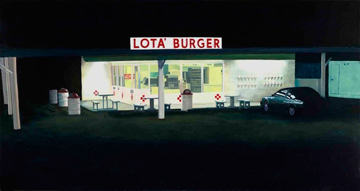
Also calls to mind the paintings of Jeffrey L. Neumann – motels, bars, eateries. Take a wild ride through his Web site, where you’ll see roadside America at its best. Pictured here is “Lota Burger” (oil, 38” x 72”), a real gem.

"Lota Burger," an oil painting by Jeffrey L. Neumann

"Lota Burger," an oil painting by Jeffrey L. Neumann

Add to Technorati Favorites
Rock Music Blogs - BlogCatalog Blog Directory