Mr. President, You’re Flunking Crisis Management 101

Mr. President, you need to find a podium, and fast. Even college freshman in PR 101 know that major crises require transparency and truth, all from the mouth of the CEO, and pronto.

Sending Napolitano and Gibbs out on such a mission is a joke, plain and simple, and a recipe for PR, even political, disaster.

Napolitano on WABC-TV “This Week” this morning said some confounding things:

That Umar Farouk Abdulmutallab was on some list, but there was nothing else to indicate he was a threat. Oh yeah, how about his distinguished banker father who weeks ago told U.S. Embassy officials in Nigeria that his son may be in the process of a terrorist act against the U.S.

Defying logic again, she had the gall to say: “everybody did what they were supposed to,” and that the government practices for exactly this type of event. Oh yeah! Even the commentator, Jake Tapper, to his credit, reminded her that the only folks who did what they were supposed to were the regular folks on that flight and the crew.

Robert Gibbs also buried the obvious failures in bureaucrat-speak about the alphabet-soup methodology of lists (i.e.: Terrorist Identities Datamart Environment, Terrorist Screening Data Base, “no-fly,” and “selectee”).

Mark my words, the ham-handed handling of this historic event on behalf of the administration will go down in PR-blunder history along with Bhopal and Exxon Valdez. This will serve as a textbook example for instructors of crisis management who will use it to point out everything not to do.

And PR aside, just wait till Leno and Letterman take to their respective podiums this week.
Add to Technorati Favorites
Rock Music Blogs - BlogCatalog Blog Directory

“Robert Frank’s The Americans” at the Metropolitan

I just saw the exhibit “Robert Frank’s ‘The Americans’” — centered on the photographer’s seminal book by the same name  — on display at the Metropolitan Museum of Art, New York, through Jan. 3.

Born in 1924 in Zurich, Switzerland, Frank took pictures in Europe and South America during his early career, but it wasn’t until he crisscrossed the seductive roads of America that Frank felt he was finally making art with his lens. With his U.S. travels in the mid-1950s, his work reached a new level, and 83 of his road images were arranged into the book “The Americans.”

It’s no surprised that Jack Kerouac wrote the introduction to the first U.S. edition of “The Americans (1959).” It raised eyebrows in the media for its brute black and white candor. But “The Americans,” like Kerouac’s own masterwork, “On the Road,” opened the door to the loneness of the country’s heart and spirit and, together, they inspired a generation of artists, musicians and thinkers.

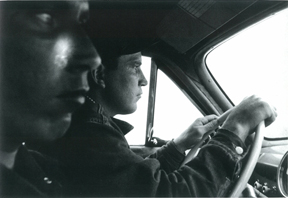
Robert Frank's "U.S. 91, leaving Blackfoot, Idaho"

It’s interesting how foreign image makers like Frank, Mechelangelo Antonioni (“Zabriskie Point,” 1970), Louis Malle (“Atlantic City,” 1980) are able to capture the essence of the land better than most native auteurs. In fact, with the stir made by “The Americans,” Frank was compared to America’s original outsider observer, Alexis de Tocqueville, whose 1835 book “Democracy in America” helped to define the young nation’s unique character (Is it what America brings to you or what you bring to her?).

I believe a great artist is a conduit for “place.” His subject somehow finds him, speaks through him. The artist ultimately “sees” through time as the French photographer Eugène Atget described it. I believe such artists also see through other dimensions, some of which elude us, some of which speak through intersections of light and shadow, artifact and art, quietude and cacophony, moment and mystery.

It’s hard to describe “The Americans.” Language could illuminate it, could degrade it. Perhaps it’s like the stuff of dreams, the magic of which begins to disappear upon transfer to the conscious mind. So much spills from the bucket on its ascent from that deep, dark well.

But I try. Actually, I thought poetry might somehow have a special access pass to the world within photography. So I offer up the following images from my forthcoming chapbook “America, I’ll Have My Way With You”:

I MISS YOU ALREADY AMERICA

I miss you already America
and you’re not even gone

leave me your messages
by the grimed phone booth
how you joke of the truth
hat tossed to eternity
leave me your hay bales
in the sweat hum of the field
waiting on farm hands
and wayward girls
leave me your Ford grillwork
idle at the company house
preaching at the two lane

leave me your truck’s whine
at the crossroads
singing that heaven
is elsewhere in the night
leave me your green trailer
singular at the corner
monument to guts
leave me your shag heart
dusting the television night
with boredom and blood

You might view the video of my song “Miss America,” too.

I was surprised and pleased to see Frank himself link the worlds of photography and poetry in his description of his work:

When people look at my pictures I want them to feel the way they do when they want to read a line of a poem twice.

Add to Technorati Favorites
Rock Music Blogs - BlogCatalog Blog Directory

Obama and Oslo: A Tough President for Tough Times

In Oslo, President Obama showed that he is more about humility than hubris and, in so doing, demonstrated why the committee gave him the Nobel Peace Prize, even if in Obama’s own characterization it could be viewed as premature:

I would be remiss if I did not acknowledge the considerable controversy that your generous decision has generated. In part, this is because I am at the beginning, and not the end, of my labors on the world stage. Compared to some of the giants of history who have received this prize — Schweitzer and King, Marshall and Mandela — my accomplishments are slight.

Yet, Obama has demonstrated how a world leader can be strong both militarily and diplomatically, without turning the free world against America as George W. did.

What surprises our politicians on both sides of the aisle is how tough this president is. He’s no wimp when it comes to using military force. In fact, he has been criticized, from the left, for sounding hawkish.

But he came to his “surge” decision in Afghanistan with the professorial scrutiny — contrary to W. — for which he is famous.
Add to Technorati Favorites
Rock Music Blogs - BlogCatalog Blog Directory

Mignini Fiddled While Rome Burned

My wife just pointed out the ironic contrast between Amanda Knox prosecutor Giuliano Mignini and Italian Prime Minister Silvio Berlusconi. While Mignini reaped the rotten fruits of his distorted moral play against Amanda Knox, a million demonstrators took to the Roman streets asking for their corrupt leader’s political head. An excerpt from an Agence France-Presse report:

Former minister Rosy Bindi said she took part as a “simple citizen” and not as a representative of the Democratic Party (PD).

“It is significant that a large part of the country is reacting against and getting angry at a prime minister who doesn’t want to be judged and isn’t solving problems,” she told AFP.

Antonio di Pietro, a former anti-corruption judge and now leader of the Italy of Values party, denounced “the Berlusconi government’s great electoral, political, judicial and media swindle”.

Participants ranged from film director Nanni Moretti, who condemned Berlusconi’s domination of Italian television, to ecologists opposed to a planned bridge across the Straits of Messina and immigrant defense groups.

Protesters shouted “mafioso” at effigies of the billionaire prime minister, referring to a Mafia hitman who testified at a trial in Turin that his boss alleged Berlusconi had aided organised crime.

In league with the Italian mafia, Berlusconi recently vowed to strangle his detractors:

If I find out who is the maker of the nine seasons of ‘The Octopus’ and who has written books on the mafia, which give such a bad image to Italy across the world, I swear that I will strangle them.

Add to Technorati Favorites
Rock Music Blogs - BlogCatalog Blog Directory

Knox, Knox. Who’s There?

Injustice.

If you have a daughter or son in college who may spend a year studying abroad, you’re likely shaken over the Amanda Knox case.

Perugia prosecutor Giuliano Mignini is himself under investigation for serious transgressions regarding abuse of power, which includes heavy-handed tactics against journalists. Florence prosecutor Luca Turco recently called for his judicial colleague Mignini to be jailed for ten months, according to a report in Britain’s The Daily Mail.

In fact, weigh in with most any American journalist who covers the case — Vanity Fair’s Judy Bachrach and West Seattle Herald’s Steve Shay, who appeared recently on CNN or Seattle Times reporters — and you’ll discover disturbing practices of jurisprudence. It becomes clear that the fathers of Perugia, a conservative city in central Italy, had it in for a free-spirited American who simply didn’t act like the locals. Couple that with a veracious tabloid press, an unvetted jury that is permitted to read and view all manner of whacky media accounts, and you have a formula for disaster. Oh, throw in the fact that the defense was not permitted to challenge suspect DNA evidence with its own experts. Talk about having the jury stacked against you.

At this point, the Knox family and Washington State Sen. Maria Cantwell are making entreaties with the state department via Hillary Clinton. The appeals process will likely commence in October. The likelihood of an appellate turnover Italian-style depends on who you talk to. I spent time in Italy as a college student. While I didn’t run up against the law, I did run into a bureaucracy that makes Washington look like a walk in the park, and I was just registering my Fiat 500.

Hopefully, appeals and pressure from the U.S. State Department and European diplomats will help tip the scales of injustice.
Add to Technorati Favorites
Rock Music Blogs - BlogCatalog Blog Directory

‘In the Heat of the Night’ Italian Style: the Amanda Knox Verdict

Fast forward to the past, the American South of old: small town justice, small town sheriff, justice by prejudice. Only now it’s Perugia, the conservative, provincial Italian town, and the victim is Amanda Knox, the “angel faced” American college student plowed under by a railroad of bad press, bad judgment and bad practices in jurisprudence.

Here are a few good sources for this disturbing story:

  1. Vanity Fair contributing editor Judy Bachrach, who lived in Italy for four years and covered the Knox trial gavel to gavel. As she explained last night on CNN, the small-town Italian justice system derives directly from “the ancient inquisition.” The Knox prosecutor is himself the subject of an inquiry regarding other recent heavy-handed practices. Also, the Italian trial system is devoid of jury vetting and defense challenges to evidence, among other primitive processes.
  2. Such Knox family members as aunt Janet Huff. Huff has an astute understanding of the Perugia phenomenon, which includes gross prejudices fueled by a paparazzi-style Italian tabloid press that distorted innocent behavior and drew false conclusions from the get-go. See Huff’s video statement.
  3. West Seattle Herald reporter Steve Shay, who draws the same conclusions as Bachrach and Knox, from his independent investigation. He commented last night on CNN, with Jim Moret who was sitting in for Larry King.

Meanwhile, as Knox’s family pursues the painful appeals process overseas, Maria Cantwell, a U.S. senator from Knox’s home state of Washington, issued the following statement:

I am saddened by the verdict. I have serious questions about the Italian justice system and whether anti-Americanism tainted this trial. I will be conveying my concerns to Secretary of State Hillary Clinton.

Add to Technorati Favorites
Rock Music Blogs - BlogCatalog Blog Directory

Breakthroughs, Bitterness and Biopics

Music biographies mesmerized me when I was a kid. Whether it was Glenn Miller or Elvis Presley, it was always the same fascinating formula: talent and tenacity leading to the precipice of success, with the artist always searching for that one elusive element to define his signature sound, to breakthrough. With Miller it was the addition of trombones. The proceedings always put me on the edge of my seat and the breakthroughs set me reeling. I guess it was in my blood.

It persists. The other night I watched two great documentary-style biopics on TV, one on Johnny Cash, another on Willie Nelson. Willie, as many of his fans may not realize, was actually a Nashville songwriter penning such classics as “Crazy,” which Patsy Cline etched into the music lexicon. Despite his preeminent status as a writer, Willie couldn’t get arrested as an artist in Music City. His quirky phrasing was way too off-beat for the 60s sound, which was infused with sweet strings and pop arrangements.

At the age of 40, Willie returned home to Texas. Such a move would have meant a life sentence selling insurance had history not intervened. As fate would have it, Woodstock Nation had opened the doors to multiple music movements by the early 70s, and Willie realized that such hippie hangouts as Austin’s Armadillo World Headquarters were ready for a new kind of country artist. He enlisted his buddy Waylon Jennings, among others, and set about launching a novel sound to a new audience. His ultimate success turned country music, and the music establishment at large, on its head. Ultimately, he was responsible for redefining music, establishing its “outlaw” class and creating the Austin revolution as well as worldwide social activism that persists to this day.

Despite his huge outsider success, Nashville rejected this giant yet again. By the 1980s, you couldn’t find a Willie song on mainstream country radio, and forget about a major label deal.

Okay, let’s get right down to the hard part. Cash was just another music god to be tumbled unceremoniously from Olympus. By the 80s, he, too, was cast out like so much trash. His popularity was dwindling, and he was struggling to find an audience and make a living.

So these outlaw outcasts banded together, literally, forming the country supergroup The Highwaymen, along with Waylon and Kris Kristofferson. Talk about a Mount Rushmore of talent. They had taken fate into their own hands and, once again, set out to redefine the music scene, outside the establishment, all on their own.

A Bronx boy, I was still getting my country legs under me, when I hit Nashville in the late 80s. At the time, I couldn’t understand why the likes of Willie and Johnny weren’t getting mainstream air play, why I could eat lunch with Emmylou Harris but couldn’t hear her songs on country radio, why Nanci Griffith was considered a darling in all the clubs, to all the execs, but couldn’t get the chart toppers and eventually carped about it in interviews.

I was just getting introduced to the hard truth of the music industry: bitterness. Griffith was bitter, my friend Artie Traum (from back home in Woodstock) — one of the sweetest guys to ever grace the business — was expressing a degree of bitterness, too, in interviews of the day. I was just learning.

The songwriting trade in Nashville was rough. By year two, I was saying you had to learn to live on a diet of stones. Rejection was the blue-plate special everyday. It took me two years to get my first major song contract and more to get my first staff writing job and my first cut. Everyone who stuck with it had war stories: the song on hold that never happened, the artist cut that got dropped by the label or never got released as a single or didn’t make it above 20 on the charts. But, despite eventual successes and even industry support, I left after a decade to pursue a career as an artist, packing scars and wisdom, love and hate.

But back to Johnny Cash. One of the greatest artists to “walk the line,” he faced the pure pain of artistry more deeply, more movingly than anyone before him. Late in his career, with the help of producer Rick Rubin, Johnny faced his inner darkness, his demons, his truth, his soul. With such albums as “American Recordings” and “Unchained,” he found a vast and vital new audience, just years before his death. His new material was so raw that family members had a tough time listening. They told him it sounded like he was saying goodbye. He told them he was.

Pure Johnny Cash

In the Cash bio, artists such as Sheryl Crow, John Mellencamp and Vince Gill expressed the true painful tumble that all artists must face. Mellencamp himself recently penned a telling if rambling article on the biz in HuffPost, a blog post that established a wellspring of conversation in the social media sector.

So, this little Bronx boy, who reeled from the Glenn Miller story and cut and broke his teeth on Music Row, finally came to understand bitterness and the role it plays in any music career. No one is exempt. It may be (excuse me) a bitter pill to swallow, but I recommend downing it to develop a good artist-immune system. Another words, one has to learn to deal with it, embrace it, pain and all, and find a way to move on. Carry it on your back, in your suitcase, in your heart, on your skin — the rose tattoo of the music artist.

Add to Technorati Favorites
Rock Music Blogs - BlogCatalog Blog Directory

‘It’s tough to beat up a guy that never quits’

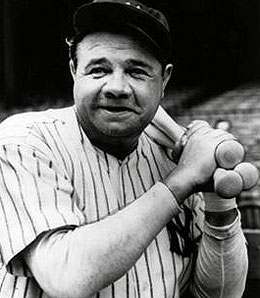
Babe Ruth mouthed that ungrammatical gem, and a slumping Nick Swisher of the New York Yankees just invoked it at a critical moment in his career.

Hang with me a moment, and you’ll see what this has to do with us music artists. Swisher made the last out in Game 5 of the American League Championship Series the other night. It was a frustrating moment, since a hit in that spot could’ve finished off the Angels and put the Bombers in the World Series.

With otherwise-clutch Swisher having only three hits in 29 at-bats this postseason, the temptation looms to sit the right fielder for another player. But manager Joe Girardi is keeping him in the lineup for the next critical game, and his reasons are exemplary. Girardi had a number of examples but the best came from his own postseason experience as a Yankees catcher. Girardi didn’t have a hit in the Yanks’ 1996 World Series as they entered a pivotal Game 6. He came through with what was to become a legendary triple. That clutch hit helped put the game and the series in the team’s column and set the stage for a dynasty period: four World Series titles in a five-year period.

Like a baseball season, a music career is a real grind. Baseball players play 162 games each season and more in the postseason, if they get there. Each year, even the best teams have high times and low. They play loose and have fun in the successful stretches and get tight when they play poorly. For short periods, even the best player can look clueless at the plate, his mechanics all out of whack. Then, inexplicably, he gets a cheap hit, and his sweet swing returns along with his confidence.

Out of the mouth of the Babe.

Out of the mouth of the Babe.

Likewise, artists at every level have similar swings, if you will. But, if you’ve had successes and you simply stay in the game, you can bet you’ll have more to build on.

Is this a pep talk? Yes. I give them to myself all the time.
Add to Technorati Favorites
Rock Music Blogs - BlogCatalog Blog Directory

Dog Guru

My wife, Roxanne and I saw Jamey Johnson last weekend in an awful club in Clifton Park, N.Y. Johnson’s a country songwriter cum recording artist who’s anything but awful. He’s one of those rare artists who come along once in a generation in a genre, in this case country.

He’s so raw and real it hurts. He’s of the outlaw breed, and his songs — even some of his hits – hold a bare light bulb to reality.

He’s a Montgomery boy, an ex-marine, ex-family man, and ex-rebel rouser, and his voice is as perfectly imperfect as his life. I’m not writing this to pitch Johnson, but country fan or not, this plainspoken poet is worth a listen.

I’m reminded of Steve Earle, who blew me away with his 1986 debut album “Guitar Town.” One literate bad boy with a voice to match. The first time I heard him I wanted to burn my guitar and typewriter (remember those), but eventually returned to my auteur senses.

Feels good to get a jolt of genius through your gut once in awhile. I find it inspirational.

What I love about guys like Johnson and Earle is their take-no-prisoners approach. They know who they are, and they live it no matter what, even if it means sacrificing at the altar of the hit-machine gods along the way.

We can all use inspiration on the long and winding road of music artistry, something or someone to keep us on the scent of who we really are. For me, it’s my labradoodle, Stella. She’s my guru. She knows things even Einstein couldn’t, but most of all she knows exactly how to follow her nose, and I follow her example daily.

Stella, my guru

Stella, my guru

Johnson follows his nose at all costs, even though there are risks along the way. His next album may not do as well. He may fade from the scene like many road geniuses before him. But, no matter what, he’ll have done it his way, and he’ll have lived a fully-realized life.

For me, it took a decade to discover my voice as a poet. In fact, when I was in college, I didn’t even know what that really meant. Then, it took yet longer to marry my poetic voice with my music, even a career as a Nashville songwriter along the way, an interesting and — as I once told New York Times pop critic Jon Pareles – circuitous journey. But I now know who I am as a recording artist and know exactly where I’m headed.

And Stella keeps me on track; and no matter what, I love the ride.
Add to Technorati Favorites
Rock Music Blogs - BlogCatalog Blog Directory

You’re So ‘Yester-moment’

It’s no longer the flavor or the month or what used to be called 24/7 or wall-to-wall coverage. The new media cycle, at least for this nanosecond, is called “perpetual movement.”

In other words, spin or die. That’s the latest from Internet guru Michael Moritz, a Sequoia investor who backed Google, Yahoo and the Sugar Inc. blog-networks.

Quoted in a recent New York Times article, Moritz says:

Perpetual movement is the essence of survival and prosperity online. If online media and entertainment companies don’t improve every day, they will just wind up as the newfangled version of Reader’s Digest — bankrupt.

A second ago, it seems, we were talking about reinventing ourselves. But that’s so yesterday, or should I say so yestermoment.

What the Suger blog people have learned of late is that content on their successful networks must change constantly.

What this overall trend spells for us music artists is even scarier than the current biz model. Maybe the Web 2.0 atomizing machine will move us even further from the album, all the way to the ring tone (do not pass digital single).

Of course, I’m kidding, but only partly. After all, it is somewhat scary. The same warp-machine that devoured major labels, newspapers and publishing may chew us into yet smaller morsels.

For myself, I’m headed into my studio to record a new three-note masterpiece. Must adapt or die.
Add to Technorati Favorites
Rock Music Blogs - BlogCatalog Blog Directory